Custom Presentation Folders: Why the Good Ones Are Hard to Find
By 360 Print Studio · September 6, 2026
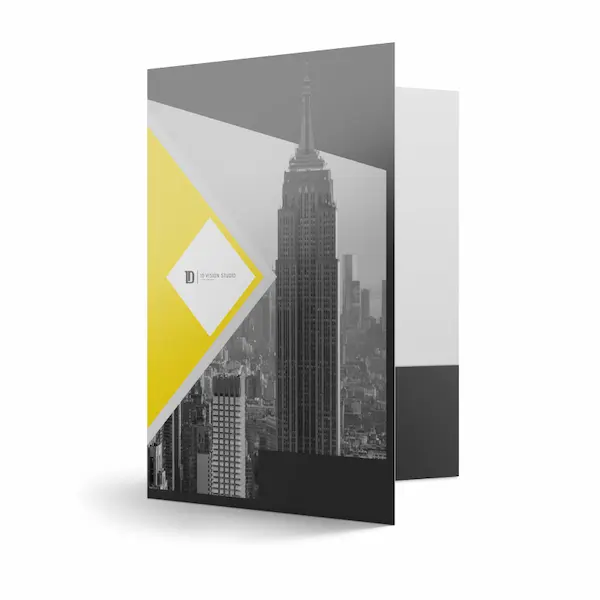
Try to buy a good presentation folder and you will notice something: the office-supply version is thin, the wrong size, and has no slit for a card, while the printed version is buried three menus deep on printer websites, priced like it is difficult to make, and often only available in quantities most businesses do not need.
There is a reason for that. A presentation folder is a converted product — printed flat, then die-cut to a shape with tabs and pockets, then folded and glued. It is more manufacturing than a flat sheet, and a lot of printers either do not offer it or treat it as a special order. So the folder ends up being the weakest piece in an otherwise sharp proposal.
This is what actually matters when you order one, and why the details are worth getting right.
The short version
- 9x12 closed is the size that holds letter paper without creasing it. Anything smaller damages the contents.
- 4-inch pockets are the working standard — deep enough to hold, shallow enough to grab.
- The business-card slit is the detail that makes a folder read as purpose-built.
- Heavy cover stock (14PT) is what keeps the folder from flopping open when it is full.
- The setup cost is the same at 100 or 1,000, so order a year of proposals at once.
The size is not negotiable
A presentation folder exists to protect and present letter-size paper. That fixes the size: 9x12 inches closed. That gives an 8.5x11 sheet room to slide in and out without catching the corners, and it leaves a margin so the pages do not stick out past the folder edge.
Folders sold at 9x11.5 or smaller are cutting the margin to save material, and the cost lands on the contents — pages that bend at the top, corners that curl, a proposal that looks handled before the client has opened it. If the folder is smaller than the paper it holds by any real amount, it is the wrong folder.
Pockets: four inches, and what that buys you
The pocket depth is the part most people never think about and the part that decides whether the folder works.
Four inches is the standard because it is the balance point. It holds a real stack — a multi-page proposal, a brochure, a spec sheet, a price list — without anything sliding out when the folder is tilted or carried. And it stops short of the top of the page, so the contents are visible and a client can pull one sheet without emptying the pocket.
Shallower pockets — two or three inches — drop their contents the first time the folder is held at an angle. Deeper pockets swallow everything so the client cannot see what is in there. Four inches is the depth that has been settled on across the industry because it is the one that works.
Two pockets, and the slit
The standard build is two 4-inch pockets, one on each inside face, plus a diagonal business-card slit cut into one of them. The slit holds a card at an angle, visible and removable, so it travels with the proposal instead of falling loose in the bottom of the folder. It costs nothing extra to add and it is the single detail that separates a folder made for presenting from a folder made for filing.
Stock: why the weight is the whole point
A presentation folder is judged in the first second, by hand, before it is opened. That judgment is almost entirely about stiffness.
Printed on a heavy cover stock — 14PT is the common weight — a folder holds its shape when you pick it up full. The spine stays square, the pockets stay put, and it reads as substantial. Printed on anything lighter, it bows in the middle, the pockets gape, and the whole thing feels disposable. At that point you have added a step and a cost to your proposal and made it look less prepared, which is the opposite of the job.
A folder that flops open when you lift it tells the client the meeting was thrown together. That impression forms before anyone reads a word.
Finish is a smaller decision. A matte coating is the safe, professional default — it resists fingerprints and photographs well. A gloss or UV coating makes color and photography pop and suits a folder that is doing more marketing than document-carrying. Either is fine; the stock weight is what is not.
When a custom folder earns its place
A printed folder is worth ordering any time the folder is handed to someone whose decision you are trying to influence:
- Proposals and pitches — the folder is the frame around the argument. A blank one undercuts it.
- Listing presentations — real estate agents live and die on the listing appointment; the leave-behind folder is what sits on the seller’s kitchen counter afterward.
- Onboarding and welcome packets — the first physical thing a new client or employee receives sets the tone.
- Media and sponsor kits — a folder keeps a multi-piece kit together and on-brand.
- Agencies presenting to clients — the folder is a chance to show the client what your production quality looks like before the project even starts.
If the contents are going in an envelope to be filed, a plain folder is fine. If the contents are going across a table, print it.
Ordering: why quantity matters more here
Custom folders have a setup step that a flat print job does not — a custom die to cut the shape, then folding and gluing. That setup is the same whether the run is 100 folders or 1,000, so the per-folder cost drops steeply as the quantity rises. Ordering 100 at a time, three times a year, costs meaningfully more than ordering 300 once.
The practical move is to design the folder to be evergreen — no dated offers, no specific campaign, just your brand and contact details — and order a year’s worth of proposals in one run. Pair it with matching business cards for the slit and a brochure sized to sit in the pocket, and the whole packet reads as one prepared thing.
Agencies and print resellers ordering folders for their own clients can quote and order them through the partner program; everyone else can spec pockets, slit, stock, and finish directly on the presentation folders page.
Ready to order premium presentation folders?
Get instant pricing →Frequently Asked Questions
What size is a standard presentation folder?
9x12 inches closed, which holds letter-size (8.5x11) paper with room to slide sheets in and out without bending the corners. This is the size that fits a standard file drawer, a briefcase, and most mailing boxes. Smaller folders exist but they crease the pages they are meant to protect.
How deep should the pockets be?
Four inches is the working standard. It is deep enough to hold a stack of sheets, a brochure, and a spec sheet without them sliding out when the folder is tilted, and shallow enough that the top of the contents is still visible and easy to grab. Shallower pockets drop their contents; deeper pockets hide them.
What is the business-card slit for?
A diagonal cut in one pocket that holds a business card at an angle so it is visible and removable without digging. It keeps the card with the proposal instead of loose in the folder, and it is the detail that makes a folder read as made for this purpose rather than generic.
What stock are presentation folders printed on?
A heavy cover weight — 14PT is the common choice. It is stiff enough that the folder holds its shape when picked up full, and it takes a matte or gloss finish cleanly. A folder printed on anything lighter flops open and feels disposable, which defeats the point of using one.
When is a custom folder worth it over a plain one?
Whenever the folder is handed to someone whose decision you are trying to influence — a proposal, a listing presentation, a pitch, an onboarding packet, a media kit. A blank folder from an office-supply store says the contents were assembled in a hurry. A printed folder says the meeting was prepared for.
What is the minimum order for custom presentation folders?
Custom-printed folders are typically ordered in the low hundreds and up, because the die-cutting and gluing setup is the same whether you order 100 or 1,000 — so the per-folder cost drops steeply with quantity. Most businesses order enough for a year of proposals at once rather than reordering in small batches.