The Print Industry Future: Why Physical Marketing Still Matters in the Age of AI
By 360 Print Studio · July 4, 2026
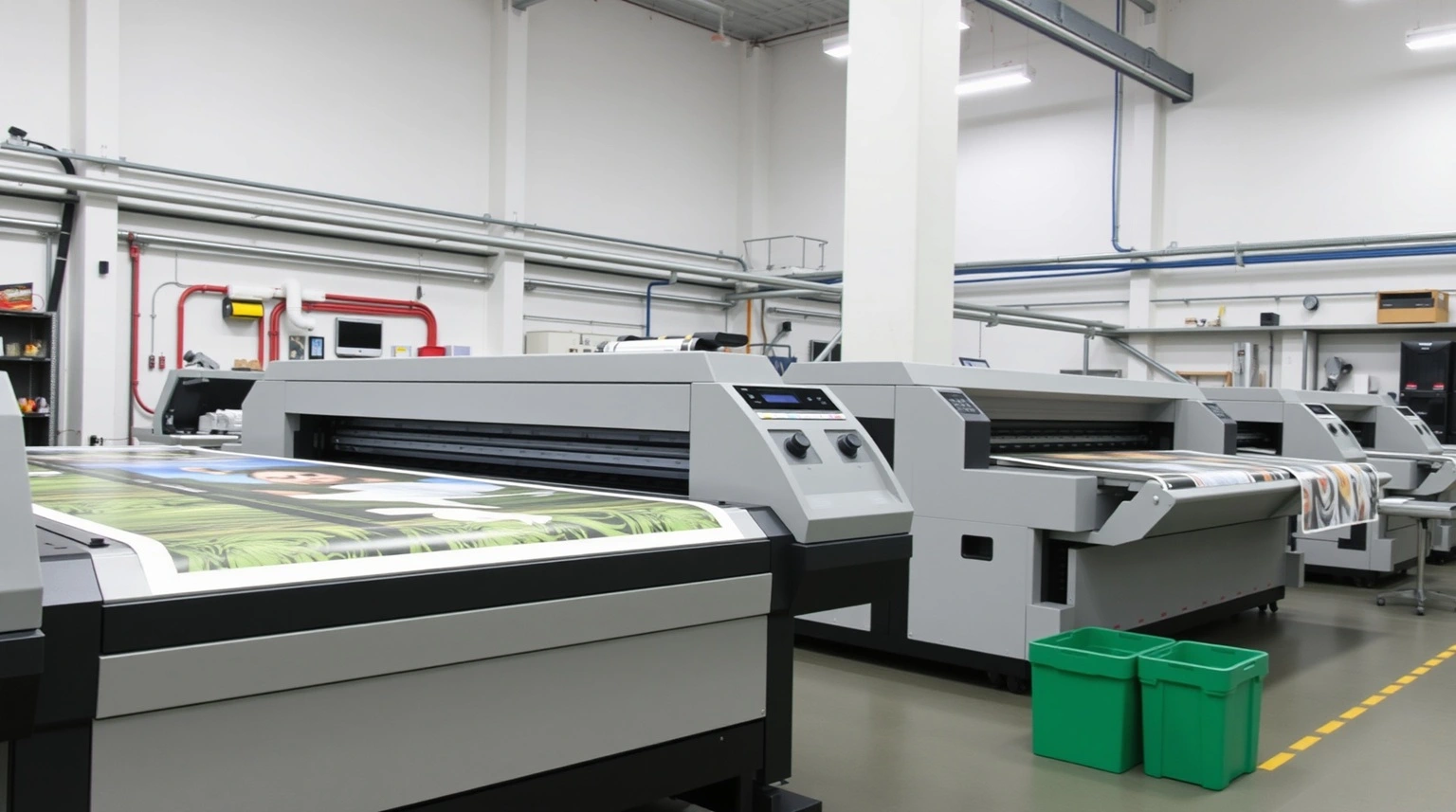
Print advertising is not dying—it is evolving. Despite decades of predictions that websites, social media, and now artificial intelligence would make physical marketing obsolete, print remains one of the most effective tools available to businesses that want to build credibility, generate leads, and stay visible in competitive markets. The reason is straightforward: print does something digital cannot easily replicate—it puts a physical object in someone’s hands.
The Prediction That Never Came True
Every wave of digital innovation has brought a fresh round of obituaries for the print industry. First, websites were supposed to make brochures and business cards irrelevant. Then social media was supposed to eliminate the need for direct mail and posters. Now, generative AI tools are being positioned as the final disruption that will make physical marketing unnecessary.
Yet here we are in 2026, and businesses across every sector—from local service providers to national brands—continue to invest in print. According to an overview of the print advertising market, the global print advertising industry maintains a substantial market presence, driven by its unique ability to command attention in ways that digital channels increasingly struggle to achieve.
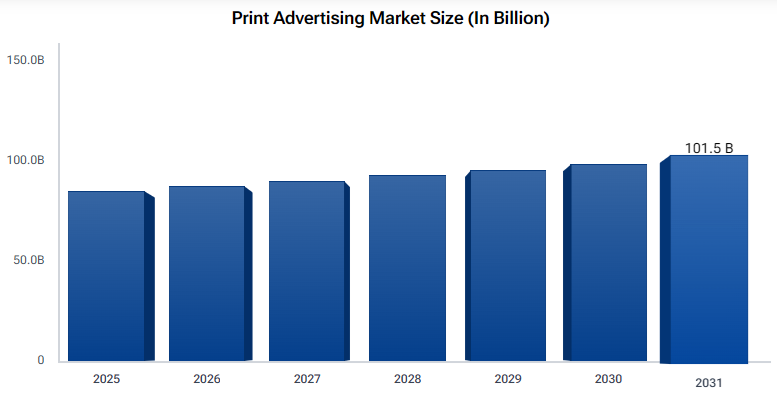 Print Advertising Market Size
The prediction that print would disappear was never really about the technology—it was about attention. And what we have learned is that physical materials compete for attention differently than screens do. They do not get blocked by ad blockers, they do not disappear in an algorithmic feed, and they do not require a Wi-Fi connection to be seen.
Why Print and Digital Serve Different Purposes
The most productive way to think about print versus digital is not as a competition but as a division of labor. Digital channels are fast, measurable, and scalable. Print is tangible, trusted, and memorable.
Research consistently shows that readers engage with physical materials more deeply than with digital content. The tactile experience of holding a well-designed postcard or a business card printed on thick 16PT card stock creates a sensory impression that pixels cannot match. That physical weight and texture signals quality, which in turn signals credibility.
This is not nostalgia—it is psychology. When a prospect holds your printed material, they are giving it deliberate attention rather than the fractured, multi-tab attention that defines most digital browsing. That moment of focused engagement is exactly what marketers are trying to buy.
The Continued Role of Business Cards, Postcards, and Posters
Business Cards at Networking Events and Trade Shows
Walk the floor of any trade show or industry conference and you will find that business cards are still being exchanged by the hundreds of thousands. A card printed on 16PT card stock with a clean, professional design communicates competence before a single word is spoken. It gives your new contact something to hold, file, or photograph—and something to find three weeks later when they are ready to follow up.
Trade show marketing depends on physical materials precisely because the environment is so sensory and fast-moving. Attendees are meeting dozens of people in a short window. A memorable card, a well-designed flyer, or an eye-catching poster at your booth gives your brand a tangible anchor in that experience.
Postcard Marketing and Direct Mail Services
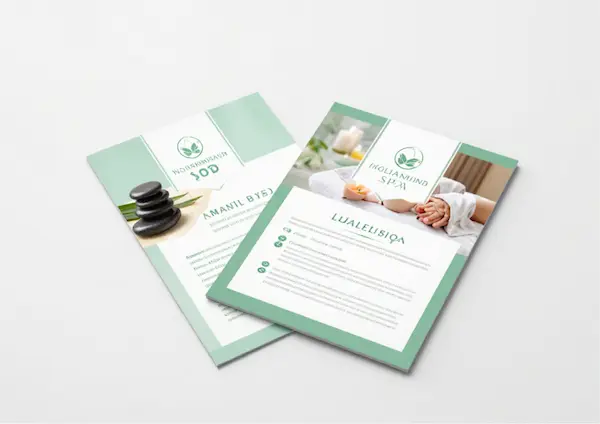 Flyers are still a great cold lead generator tool
For local businesses, postcard marketing and direct mail services remain among the most reliable tools for customer acquisition. A postcard does not require the recipient to opt in. It arrives in their hands without competing with hundreds of other notifications. And when it is designed well—with a clear offer, a strong call to action, and a QR code linking to a landing page—it functions as a direct response mechanism that is entirely trackable.
Local restaurants, real estate agents, contractors, medical offices, and retail businesses all continue to rely on direct mail to reach neighborhoods with precision. The combination of geographic targeting and physical presence gives direct mail an engagement quality that display advertising rarely achieves.
Poster Printing for Events, Branding, and Visibility
Large-format poster printing serves a purpose that no digital channel can replicate: it occupies physical space. A poster in a storefront window, at a community center, or at an event venue puts your brand exactly where your audience is—without requiring them to be online.
For event organizers, retail brands, and businesses promoting seasonal campaigns, posters provide passive but persistent visibility. They work while you sleep. And combined with a QR code or social handle, they become entry points into your broader digital ecosystem.
Explore the full range of print products available at 360 Print Studio to find the right format for your next campaign.
How AI Is Making Print Smarter, Not Obsolete
Artificial intelligence is reshaping marketing workflows, but its impact on print is largely additive. AI tools are helping businesses design faster, segment audiences more accurately, and personalize printed materials at a scale that was previously impractical.
Variable data printing—one of the most significant developments in modern print production—allows each piece in a print run to be individually customized. A direct mail campaign can now address each recipient by name, reference their neighborhood, and present an offer tailored to their purchasing history. This kind of personalization was once the exclusive domain of email marketing. Now it is a standard capability in print.
According to recent analysis of print marketing trends, the convergence of data-driven targeting and physical print production is one of the defining directions for the industry. AI supports the strategy; print delivers the experience.
Design automation is also reducing the time and cost associated with preparing print-ready files. Templates driven by brand guidelines can generate personalized layouts at scale, ensuring consistency without sacrificing customization. This makes print campaigns more accessible to small and mid-sized businesses that previously found personalized direct mail too complex to manage.
Print as a Pillar of Omnichannel Marketing
Modern marketing strategy is built on the idea that customers interact with brands across multiple touchpoints before they make a decision. An omnichannel approach means being present—consistently and coherently—wherever your audience is, whether that is a social media feed, a search engine, an email inbox, or their physical mailbox.
Print strengthens an omnichannel strategy by creating a touchpoint that is distinct from every screen-based channel. A postcard with a QR code drives traffic to a landing page. A business card connects to a LinkedIn profile. A poster at an event reinforces a brand that someone first encountered through an Instagram ad. These are not competing interactions—they are compounding ones.
The emerging trends in print marketing point toward deeper integration between print and digital: augmented reality triggers embedded in printed pieces, personalized URLs on direct mail, NFC-enabled business cards, and sustainability-certified paper stocks that align with brand values. Print is not retreating from the digital age—it is adapting to work within it.
Sustainability is also reshaping how businesses think about print. Buyers are increasingly asking for FSC-certified paper, vegetable-based inks, and responsible production practices. This shift makes print not just a tactical tool but a statement of brand values.
The Future of Print in Business Development
The print industry future belongs to businesses that treat physical materials not as an afterthought but as a deliberate strategic choice. A well-executed direct mail campaign, a professionally printed trade show kit, or a set of premium business cards does not signal that a brand is living in the past. It signals that the brand understands how to command attention across every channel that matters.
The businesses that will benefit most from print in the coming years are those that use it with intention—pairing it with data, integrating it with digital campaigns, and investing in the quality of materials that reflect the quality of their brand.
Browse the full catalog of print products at 360 Print Studio to start building a print strategy that works alongside your digital efforts.
Print Is Not Dying—It Is Becoming More Strategic
The story of print is not one of decline. It is one of refinement. The volume of print has changed, but the role of print has grown sharper and more purposeful. Every piece that goes to press today competes in a world where digital noise is at an all-time high—which means a beautifully designed, thoughtfully targeted physical piece has more relative impact than ever.
Business cards still open doors. Postcards still fill appointment books. Posters still stop people in their tracks. And direct mail still converts prospects into customers. What has changed is not the power of print—it is the sophistication with which smart businesses are using it.
Ready to order premium ?
Get instant pricing →Frequently Asked Questions
Is print advertising still effective in 2026?
Yes. Print advertising continues to deliver strong results, particularly for brand recall, local outreach, and trust-building. Research shows that physical materials engage readers more deeply than digital ads, and direct mail consistently produces higher response rates than many online channels.
How do business cards help at trade shows and networking events?
Business cards create an immediate, tangible connection that digital contact sharing cannot fully replicate. A well-designed card printed on premium stock—such as 16PT card stock—leaves a lasting impression and keeps your brand top of mind after the event ends.
What is variable data printing and how does it help marketers?
Variable data printing allows each printed piece to be customized with unique names, addresses, offers, or images while running on the same press pass. This makes direct mail campaigns far more personalized and relevant, which improves response rates significantly.
How do QR codes connect print materials to digital campaigns?
QR codes printed on postcards, flyers, posters, or business cards give recipients an instant bridge from physical material to a landing page, video, or online offer. This makes print a functional part of an omnichannel marketing strategy rather than a standalone channel.
Are postcards still worth using for local marketing?
Absolutely. Postcards are cost-effective, highly targeted, and tangible. They land directly in a prospect's hands without competing with inbox clutter, and they work especially well for local businesses promoting offers, events, or seasonal services.
How is AI changing the print industry?
AI is streamlining design workflows, enabling smarter audience segmentation for direct mail, and supporting variable data printing at scale. Rather than replacing print, AI is making print campaigns more precise, personalized, and cost-efficient.
What print products work best for trade show marketing?
Business cards, brochures, flyers, and large-format posters are all essential for trade show marketing. Together, they create a cohesive brand presence—drawing visitors to your booth and giving them something tangible to take home and remember you by.